Why evals decide whether AI products live
Why evals decide whether AI products live
Curriculum Module 1 / Lesson 1.1. Lab shape: trace-detective. Runtime: in-browser Python (Pyodide — a Python runtime that runs in the browser) and local starter workspace (courses/evals-engineering/).
Watch it fail
A billing team launches an AI support assistant that answers refund requests. The policy has two clauses:
- Standard plans qualify for a full refund only within 30 calendar days of purchase.
- Enterprise plans also qualify after 30 days when there is a verified service-level agreement (SLA) breach (a documented outage violating contracted uptime).
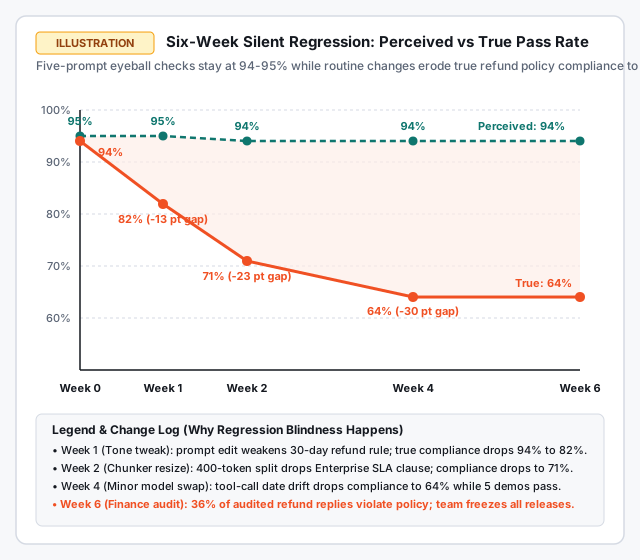
Before launch, an engineer pastes five favourite test prompts into a chat window. Four of the five look great, one is borderline, and the team records a 95% pass rate. Look at what happens over the next six weeks as routine improvements ship:
- Week 0 — Launch. On real customer traffic, the assistant follows policy on 94% of tickets. The five-prompt eyeball check reads 95%. [ILLUSTRATION — simplified]
- Week 1 — Tone tweak. A product manager asks the team to make the assistant sound warmer. An engineer adds "Always prioritize customer delight and resolve frustration generously" to the system prompt, re-runs the five favourite prompts (95%), and merges. On live tickets, frustrated customers at day 45 start receiving unauthorized $240 refunds. True policy compliance drops from 94% to 82% — a 13-percentage-point blindness gap. [ILLUSTRATION — simplified]
- Week 2 — Retrieval chunk resize. To cut latency, another engineer halves document chunk size from 800 tokens to 400 tokens. The Enterprise SLA exception clause (Section 4.2) splits into a second chunk that falls out of top-1 retrieval. Enterprise customers at day 38 with confirmed outages are now falsely denied. True compliance drops to 71%; the five-prompt check reads 94%. [ILLUSTRATION — simplified]
- Week 4 — Minor model version swap. A routine model checkpoint update slightly shifts how date arguments are formatted in tool calls. True compliance drops to 64%; the five-prompt check still reads 94%. [ILLUSTRATION — simplified]
- Week 6 — Finance audit. Accounting closes the quarter and finds that 36% of audited refund replies violated policy (64% true compliance). Because nobody measured which change broke which slice, leadership freezes all prompt and retrieval deploys. [ILLUSTRATION — simplified]
Before you scroll: why did the five-prompt check stay at 94–95% while one in three real tickets failed? Write one sentence.
(This six-week trajectory is a synthetic teaching fixture drawn from recurring production failure patterns. Every number is locked in the lesson fixture and computed in the practice cell.)
The mental model
An eval is not a public leaderboard score or a five-prompt vibe check. It is a measurement system with an owner, a budget, and a concrete decision it feeds.
Compare the three ways teams judge an AI system:
| Approach | What it actually tests | Decision it can honestly support |
|---|---|---|
| Vibes (eyeball testing) | 3–5 prompts the author remembers to paste into chat | None — creates prompt astrology (debating adjectives in pull requests without data) |
| Public benchmark | Someone else's static exam on general capability | Narrowing 20 candidate base models down to 2–3 before you test on your own data |
| Product evaluation system | Your task specification, your failure slices, your binary pass/fail graders | Block or merge a pull request; page on-call or stay quiet; promote or roll back a release |
Interview sentence: Brakes do not exist to make a car go slow — they exist so you can drive fast without going off a cliff.
The mechanism: the three loops
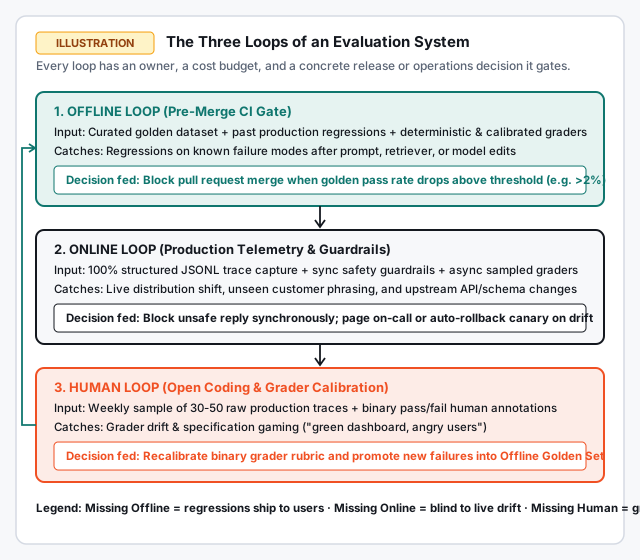
No single test suite catches every failure. A working evaluation system closes three distinct loops, each catching what the others miss:
| Loop | When it runs | What it inspects | What it catches | Decision it gates |
|---|---|---|---|---|
1. Offline loop (offline) | Pre-merge (every pull request or prompt/model edit) | Curated golden dataset + past production regressions | Regressions on known edge cases before a single user sees the change | Merge or block the pull request |
2. Online loop (online) | In production (live traffic) | Structured traces, synchronous guardrails, sampled async graders | Unknown live drift: new customer phrasing, broken upstream APIs, distribution shift | Block an unsafe reply in flight; page on-call or roll back a canary |
3. Human loop (human) | Weekly calibration & trace review | 30–50 raw production traces read by a human with binary pass/fail labels | Grader blindness: when your automated grader says 97% pass while users are churning | Recalibrate the automated grader and promote new failures into the offline golden set |
Notice two design rules that govern all three loops across this entire course:
- Binary verdicts (
PASS/FAIL), never 1–5 Likert scales. Asking a reviewer or an automated judge to rate a response "3 out of 5 vs 4 out of 5 on helpfulness" produces noisy averages that hide policy violations. Instead, decompose quality into crisp binary checks: Did the assistant issue a refund past 30 days on a Standard plan? (True/False). - A metric without a decision rule is dashboard theater. If a score can drop 15 percentage points and the pull request still merges automatically, you do not have an evaluation gate — you have a chart.
Inspecting raw traces & the starter workspace
Open the interactive Local Offline Trace Explorer (no API key, zero network calls). Three multi-span traces from the Billing Support Assistant (trace_w0_001, trace_w1_002, trace_w2_003) are pre-loaded:
- Click
trace_w1_002(Week 1 warm-tone regression) and expand its five spans:root→retrieval→tool_call→completion→parse. Notice thatretrievalfetched the exact 30-day rule andtool_callreturneddays_since_purchase: 45, yetcompletionoverrode the boundary andparseexecuted a $240 refund. - Click
trace_w2_003(Week 2 chunker regression). Here the model followed the retrieved text faithfully — the bug sits inside theretrievalspan, where the 400-token chunk split dropped Section 4.2.
In your local starter workspace (courses/evals-engineering/), run the offline smoke suite against the recorded YAML cassette ($0, outbound sockets blocked by default):
cd courses/evals-engineering
pytest modules/m01_eval_mindset/l01_1_why_evals/ -k "not student" -v
The course map: what you will assemble
Across 12 modules, you will build one complete evaluation harness layer by layer:
- Modules 1–3 (Foundations & Data): the three-loop mindset, open coding 30–50 raw traces into a grounded failure taxonomy, and constructing a coverage-matrix golden dataset (
datasets/v1/). - Modules 4–5 (Graders & Calibrated Judges): fast deterministic code/schema graders first, followed by bias-tested binary automated judges calibrated against human labels with TPR/TNR correction.
- Modules 6–9 (Architecture & Stress): component-level diagnostics for retrieval (
2x2context vs faithfulness), tool use and multi-step agent trajectories, multi-turn memory probes, and adversarial safety/robustness suites. - Modules 10–12 (Decisions, CI/CD & Capstone): bootstrap confidence intervals, McNemar paired tests, two-tier CI gates, live production guardrails, and your end-to-end Capstone scorecard and ship/no-ship release memo.
The failure mode
Treating one loop as the whole system:
- Offline-only ("Pre-Merge Bubble"): 100% green CI while an upstream schema change breaks live production.
- Online-only ("Live Firehose"): shipping unvetted prompt edits straight to customers and discovering regressions days later from angry tickets.
- Uncalibrated automation ("Autopilot Lie"): trusting an automated grader for months without checking whether its binary verdicts still agree with a human reading raw traces.
The lab
Open the practice cell below (or courses/evals-engineering/modules/m01_eval_mindset/l01_1_why_evals/exercise.py locally). Five fictional team setups (A–E) and the six-week billing regression timeline are loaded. Every diagnosis slot starts blank (None):
- Replace each
Noneindiagnoses("A"through"E") with the matching tag fromDIAGNOSIS_TAGS:"missing_offline_loop""missing_online_loop""missing_human_loop""no_decision_rule""complete_three_loop_system"
- Replace
first_broken_week = Nonewith the integer week where the blindness gap (perceived_pass_pct - true_pass_pct) first exceeds10.0percentage points.
Run the cell (or pytest modules/m01_eval_mindset/l01_1_why_evals/). Every wrong pick prints a specific diagnostic hint until all checks pass. Practice seed is locked at 0. No API key.
One-line close
If a metric cannot block a bad change or trigger a rollback, it is decoration — not an evaluation.
What breaks next: once a team agrees it needs all three loops, they almost always build them in the wrong order — writing 200 synthetic automated tests before looking at a single real production failure (Lesson 1.2: The Analyze–Measure–Improve lifecycle).
Home numbers / honesty table
| Item | Value | Label |
|---|---|---|
| Six-week perceived pass rates (Weeks 0, 1, 2, 4, 6) | 95%, 95%, 94%, 94%, 94% | ILLUSTRATION fixture |
| Six-week true pass rates (Weeks 0, 1, 2, 4, 6) | 94%, 82%, 71%, 64%, 64% | ILLUSTRATION fixture |
Blindness gap (perceived - true) | 1%, 13%, 23%, 30%, 30% | REAL: computed in cell & prove-home-numbers.py |
First week with gap > 10% | Week 1 (13% gap) | REAL: computed in cell & test_exercise.py |
Fixture trace count (sample_support_trace.jsonl) | 3 traces, 5 spans each | ILLUSTRATION fixture |
| Cassette replay cost | $0.00 (sockets blocked in conftest.py) | REAL: verified by test_offline_socket_guard_blocks_live_network |
| Lesson video | not shipped | Manim script in docs/evals-engineering/curriculum/modules/m01/media/l1-1-three-loops.py |
Video
No rendered lesson video is shipped in this build. A Manim script for this lesson exists in the curriculum docs under the repo (docs/evals-engineering/curriculum/modules/m01/media/l1-1-three-loops.py); it is a plan for a future render, not a playable file linked from this page.