Vectors as Lists and Arrows
Vectors as Lists and Arrows
Scenario
Suppose you cross a room in two walks.
First you take one step east and two north. Then you take two steps east and one south. Where do you stand when both walks are done?
That is the question this lesson answers. Write the first walk as and the second as . South is negative north, so the minus sign on the second list is doing real work: that walk ends below the axis, not above it. Do the walks in order. East you add the first slots: . North you add the second slots: . You land at . The single arrow from the origin to is the sum.
A few answers look almost right and are wrong, the way a spam score of looks like a probability until you remember probabilities live in :
- — the minus on was dropped, so north was treated as or .
- — only the first walk was kept.
- — the slots of the first walk were swapped.
Keep the minus. Add the partners. The tip is .
Instead of starting from “what is a vector?”, we ask:
- What do these two numbers mean together?
- What happens if we swap them?
- Where does the tip sit if we do both walks?
- When can we not add at all?
Those two operations — add two lists, and multiply a list by an ordinary number — are the rest of the course in miniature. Mixes of columns, solving , projections: the same two acts, used over and over. Today we learn to see a vector clearly, and to see why adding on paper is the same act as adding in a picture.
The clip walks those numbers in the same order: as a list, then as an arrow from the origin; the same way; tip-to-tail; why the tip is ; then two lists of different lengths.
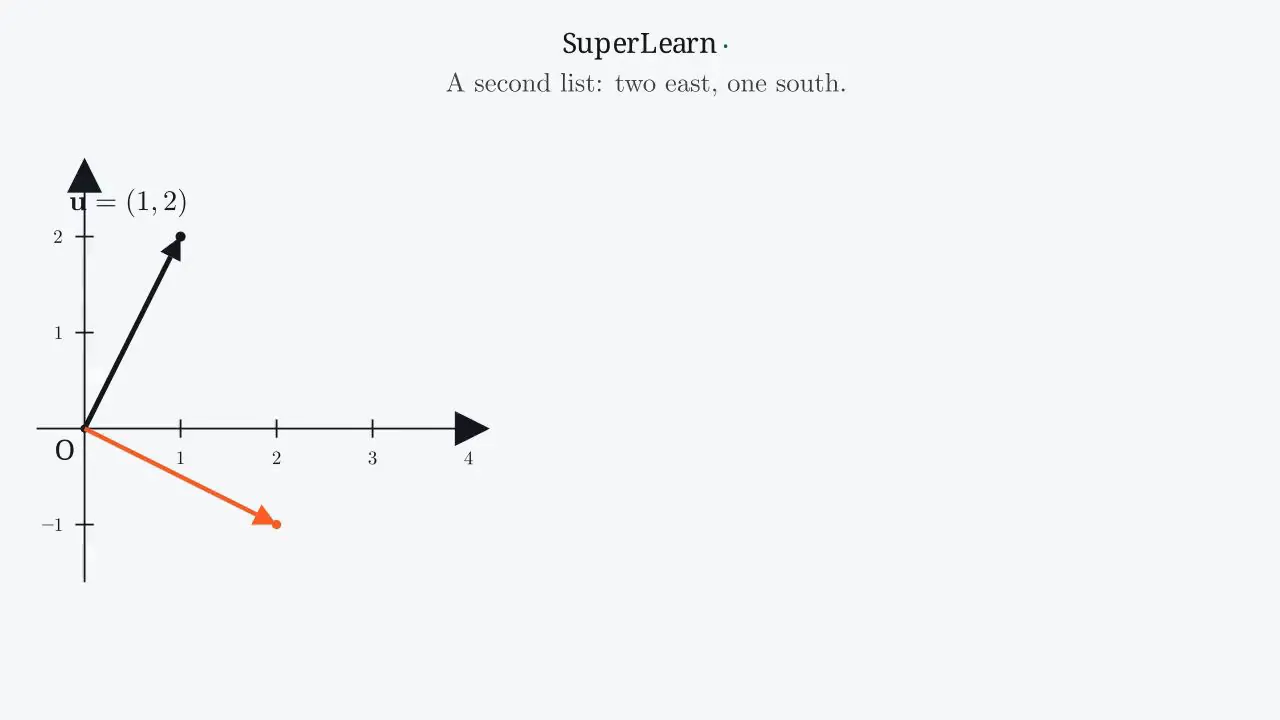
A list of numbers
The first walk is already a vector: an ordered list of numbers that travel together. The brackets are not decoration. They say order is an axis. The first slot is how far along the first axis. The second slot is how far along the second axis. Read as one step east and two steps north.
Swap the slots and you have a different object. is not the same as : two east and one north. Same digits, different landing. A slot is not “a number we happen to have.” It is a direction.
A third list from the same rule: is two west and three north. The minus sign is not a footnote. Negative means the other way along that axis.
You can have three slots, or four, or a hundred. Each extra slot is one more axis. The idea does not change. Today we live mostly in two slots so the picture fits on a page, then use three- and four-slot lists to see where addition stops making sense.
The same list is an arrow
Take that list and draw it.
Put the tail at the origin . Put the tip at the point whose coordinates are the list. For that point is . The arrow from to is the vector. Change the first slot from to and the tip must move to — or, if you meant to swap the slots, to . The picture has to follow the list.
Why the origin? So the coordinates of the tip are the list. In this course, “the vector ” means that arrow from . You will later slide a copy of an arrow to a new starting point — that is how addition is drawn — but sliding a copy does not change the list. The list still says two east and one south, or one east and two north, wherever you park the tail.
You need both faces. The list tells you which numbers to add. The arrow tells you what those numbers mean in space. If you can switch without losing a number, you can check a picture against the arithmetic instead of trusting whichever one looks nicer.
Two pictures of the same sum
There are two honest ways to draw . They look different. They are not two definitions.
From the origin. Draw both arrows leaving . One tip sits at , the other at . The sum is a third arrow from to . You see the two walks and the landing at once.
Tip-to-tail. Keep the first arrow where it is, tail at , tip at . Copy the second arrow and park its tail on that tip. You have not changed the second list — still means two east and one south. You only moved where you started drawing it.
Watch the new tip. You were already at . From there you walk two more east and one south. The new coordinates are . Parking on the tip of is adding the slots. That is why the picture and the arithmetic agree. The single arrow from the origin to that final tip is the sum again.
Both drawings land in the same place. The parallelogram they make is a check, not a third definition. Complete the fourth corner: from , along , then along ; or along , then along . Addition does not care about order, so both paths hit . If the far corner sits anywhere else, you drew a different pair of lists.
Adding slot by slot
Addition is defined only when every slot has a partner. Then you add the partners:
The second slot is . That is the north component. The tip is . The same two sums show up later as a mix of columns, , and they still land at . Today we only need the sum.
The same rule works with more slots. Three and three:
.
First with first, second with second, third with third. No picture on this page will show four axes, but you do not need one: if the slots line up, you add them.
Those two operations — add, and multiply by a number — are already enough to make a combination. Taking one of and one of is , and that lands at too. Later you will put those two lists as columns of a matrix. The numbers will not change. The picture around them will.
Figure
The still holds both drawings of the home sum. The teal tip is the claim: check it against and . It must sit at .
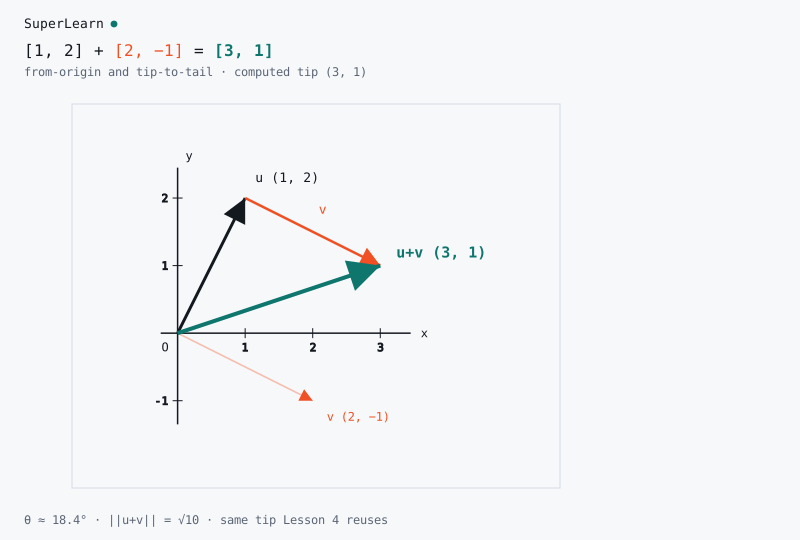
One plus two is three east. Two plus minus one is one north. The ink arrow is , the ember arrow is parked tip-to-tail, and teal is the landing.
A short sequence walks the same numbers one idea at a time: two walks from the origin, the list as slots, the arrow from to , tip-to-tail to , why east and north, then why three slots plus four slots have no sum. The SVG above stays the computed truth.
Lab
You just saw parking on land at . The teal arrow here is that same sum, recomputed from the slots you set.
Try this: change the second slot of from to . The tip must leave and move with still doing the north work — the new landing is only because you changed a slot, not because the minus disappeared. Reset returns to . If a slider moves and the teal tip does not, the lab is not adding the slots you set.
Flip the length-mismatch control after you trust the home tip. A length-3 list plus a length-4 list refuses to draw, because there is no matching slot.
Scaling
A scalar is an ordinary number that stretches or flips the arrow you already have. It is not a vector. Twice is twice each slot:
The new arrow still points the same way, just twice as far: from to . A negative scalar reverses it. Zero collapses it to the origin. Scaling does not invent a third axis. It only moves the tip along the line the arrow already lives on.
In general, for any number :
The same three numbers can sit as a column or as a row . Orientation will matter when matrices enter. For this lesson’s tip-to-tail picture we draw columns from the origin.
When addition has no meaning
A length-3 list and a length-4 list do not have matching slots. There is no third list to write, and no tip to draw.
has three numbers. has four. The first three slots could be added, but the fourth slot of the second list has no partner. Different-length lists cannot be added.
Padding the shorter list with a zero would invent a fourth axis the first vector never had. Writing is a different list, and a different problem, with a different sum.
So is undefined. Three slots plus four slots is not a walk.
The next lesson takes two lists of the same length and turns them into one number — the dot product.